
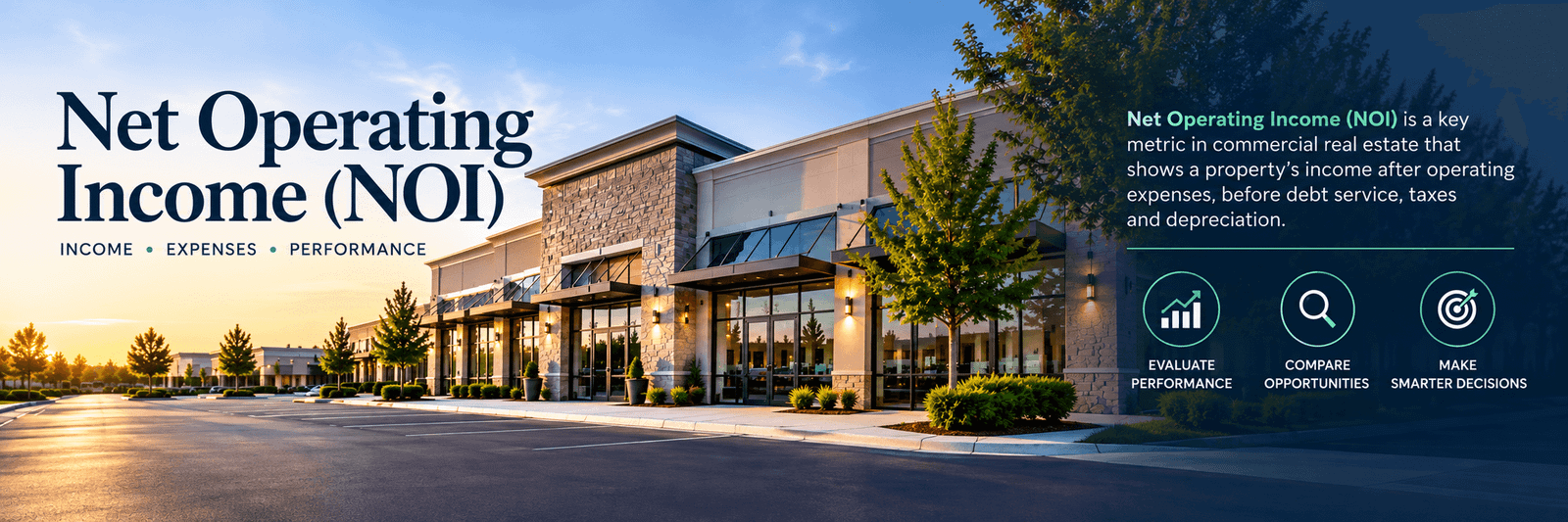
Every investor I talk to knows what NOI stands for. Fewer of them know how to build one that will actually survive contact with reality. I’ve watched deals blow up in escrow, and I’ve watched deals close at prices that made no sense a year later, all because somebody trusted a Net Operating Income number they never stress-tested.
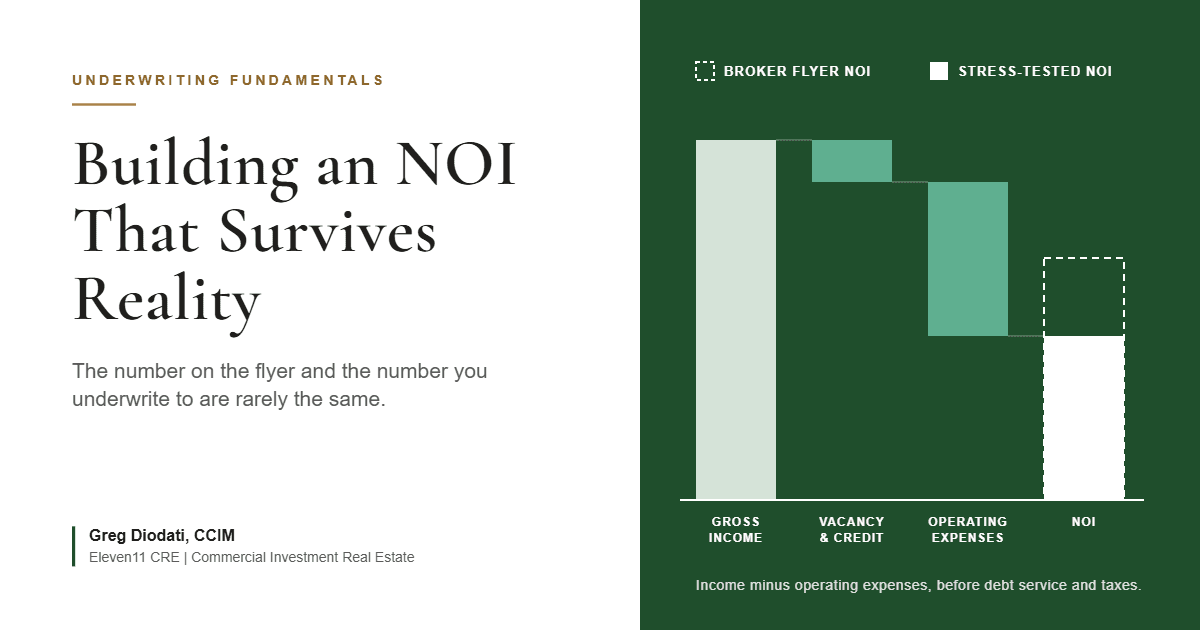
NOI isn’t complicated math. It’s income minus operating expenses, before debt service and before taxes. But the number on a broker’s flyer and the number you should underwrite to are rarely the same thing. Here’s how I build NOI for my own analysis, and how I pressure-test it before I let a client write an offer.
What NOI Actually Is (and Isn’t)
NOI is gross income from the property, minus vacancy and credit loss, minus operating expenses. That’s it. It doesn’t include mortgage payments, it doesn’t include capital expenditures, and it doesn’t include income taxes.
I bring this up because I still see sellers and even some brokers slip debt service or a one-time capital item into an NOI calculation to make a property look better or worse than it is. On an industrial building I looked at in West Sacramento a couple years back, the seller’s package had “NOI” listed after backing out a roof replacement as an expense. That’s not NOI. That’s cash flow after capex, and it’s a different number entirely.
Keep these separate. NOI tells you what the real estate itself produces. Debt service and capex tell you what you personally get to keep. Conflating them is how buyers overpay.
How I Build an NOI From Scratch
I never just accept a seller’s pro forma. I rebuild it line by line, usually starting with 3 years of actual operating statements and the current rent roll.
On the income side:
Start with gross scheduled rent at current in-place leases, not asking rents. If a lease is below market, that’s an opportunity, but it’s not today’s income. If a lease is above market, that’s a risk at renewal, and I’ll flag it.
Subtract a realistic vacancy and credit loss factor. For Sacramento industrial right now, I’m underwriting most stabilized assets at 5% to 7% vacancy even in a tight market, because turnover costs money and downtime is real. If a property has one tenant occupying 100% of the space, I model a higher factor, because single-tenant risk is concentrated risk.
Add in reimbursement income if the leases are NNN or modified gross. This is where I see the most errors. Reimbursements should tie directly to the actual operating expenses below, not to some inflated number the seller wants to hit.
On the expense side, I build a full operating expense schedule: property taxes (recalculated at the new sale price if there’s a Prop 13 reassessment trigger, which matters a lot in California), insurance, common area maintenance, management fees (even if the owner self-manages, I underwrite a market management fee, typically 3% to 5%, because that’s a real cost a buyer will incur), and a reserve for structural repairs and replacements.
The Expenses People Forget
I had a client in 2023 who almost bought a 45,000-square-foot industrial building in Rancho Cordova based on a seller-provided NOI that excluded property management entirely, because the seller was the owner-occupier’s cousin and ran it as a favor. Strip that out and add a market management fee, and the cap rate on the deal moved from 6.2% to 5.7%. That’s the difference between a good deal and a mediocre one.
Other line items I see missed constantly:
Reassessed property taxes after sale. California buyers get burned on this one more than anywhere else. If a property has been held for 20 years, the current tax bill reflects a fraction of the new purchase price. Model the post-sale number, not the trailing number.
Roof and paving reserves on industrial buildings. These aren’t optional line items you can skip because nothing’s broken yet. A 100,000-square-foot roof doesn’t last forever, and neither does a truck court.
Non-recoverable expenses under NNN leases. Even in a clean triple net structure, there are usually a few costs the landlord eats: roof and structure repairs, capital items, vacancy-period expenses on unleased space. Don’t assume 100% recovery just because the lease says “triple net.”
Stress-Testing NOI Before You Buy
Once I have a defensible NOI, I run it through a few scenarios before I trust it enough to build a cap rate or IRR analysis on top of it.
First, I model lease rollover. If a major tenant’s lease expires within the hold period, what happens to NOI if they leave and the space sits vacant for 6 to 9 months during a re-tenanting? I run that as a real line item in year 3 or year 5, not as a footnote.
Second, I test expense inflation against flat or slow-growing rent. Property taxes, insurance, and utilities have all been climbing faster than 3% a year in California recently. If your rent escalations are fixed at 3% annually and your expenses are growing at 5%, your NOI margin compresses every year even with 100% occupancy. I’ve had clients shocked when I show them that math on a 10-year hold.
Third, I ask what the NOI looks like at 85% occupancy instead of 95%. Not because I expect it, but because I want to know how much cushion exists before the deal stops making sense. If a property only works at full occupancy with no downtime ever, it’s not a conservative underwrite, it’s a bet.
Fourth, on single-tenant net lease deals, I look hard at what the space is actually worth to a second tenant if the first one walks. A building custom-built for a food processor with specialized refrigeration isn’t the same asset to a general industrial user. That re-tenanting risk needs to show up somewhere in your NOI assumptions, usually as a longer downtime and a bigger capital allowance for retrofit.
A Real Example
I worked a deal last year on a multi-tenant industrial park near the airport, about 120,000 square feet split among 6 tenants. The seller’s marketing package showed NOI of just over $780,000, priced at a 6% cap rate, which put it around $13 million.
When I rebuilt it, actual trailing NOI was closer to $712,000. The seller had included a vacant suite at full pro forma rent that had been empty for 14 months, used a management fee that was half the market rate, and hadn’t accounted for a tax reassessment. At a 6% cap on the corrected number, that same property was worth closer to $11.9 million, more than a million dollars off the marketed price.
My client ended up buying it, but at $12.1 million after negotiation, using the rebuilt NOI as leverage. That’s the whole exercise in one deal. The seller wasn’t lying, exactly. They were just presenting the most favorable version of a number that had a lot of room to be favorable.
Practical Takeaways
Before you underwrite any acquisition, do these things:
Rebuild NOI from actual operating statements and the current rent roll, never from a seller’s summary pro forma alone.
Keep debt service, capital expenditures, and income taxes completely out of the NOI calculation.
Recalculate property taxes at the post-sale assessed value, especially in California.
Underwrite a real vacancy factor and a market-rate management fee, even if current ownership doesn’t pay one.
Run the NOI at reduced occupancy and with expense growth outpacing rent growth to see how much margin you actually have.
Get a broker or advisor who will rebuild the number with you line by line before you ever get to a cap rate or an offer price. A wrong NOI doesn’t just produce a wrong valuation, it produces a wrong decision on one of the largest purchases you’ll make.
About Greg Diodati, CCIM
Greg Diodati, CCIM is a commercial real estate broker with RE/MAX Gold Commercial, serving Sacramento Metro. Since 1982, he has advised commercial property owners, investors, landlords, tenants, buyers, and business owners, with particular focus on commercial investment real estate and industrial properties.
STAY IN THE LOOP