Fed’s Quarter-Point Rate Hike Adds Another Headwind for Commercial Real Estate
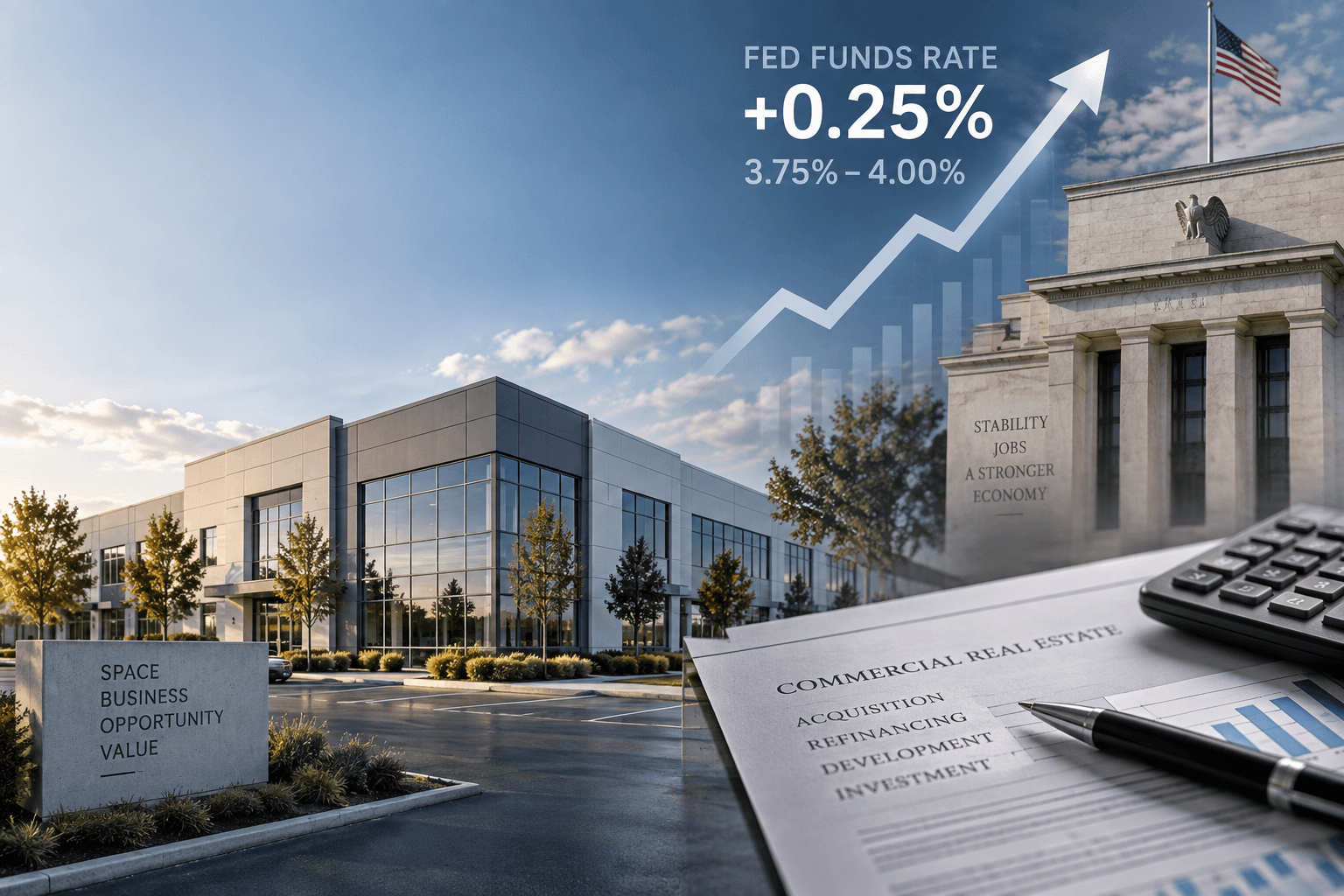
The Federal Reserve raised its benchmark federal-funds rate by 25 basis points yesterday, moving the target range to 3.75%–4.00%. The unanimous decision reflects the Fed’s continuing concern that inflation remains elevated, and policymakers indicated that additional tightening may still be possible.[reuters][cnbc]
For commercial real estate, the increase is modest in isolation—but it arrives when many owners, buyers, lenders, and developers are already contending with a slow transaction environment, difficult refinancing conditions, elevated cap rates, and a wide gap between seller expectations and buyer pricing.
Why a quarter point matters
A 25-basis-point move does not mean every commercial loan rate automatically rises by 25 basis points. CRE borrowing costs are influenced by the relevant Treasury yield or SOFR index, lender spreads, property type, leverage, sponsorship, debt-service coverage, and capital-market sentiment.
Still, the Fed’s move matters because it reinforces a higher-for-longer borrowing environment. It raises the cost of floating-rate debt almost immediately and can influence the pricing and availability of new permanent loans, bridge loans, construction financing, and lines of credit.
The more consequential message may be the Fed’s outlook: inflation remains a concern, and borrowers should not assume that materially cheaper capital is around the corner. Reuters reported that the Fed raised rates for the first time since 2023 and signaled further increases could follow.[reuters]
Impact on an already slow CRE market
Commercial real estate has been operating in a market defined less by a lack of interest than by a lack of agreement. Buyers want pricing that reflects today’s financing costs and risk. Many sellers remain anchored to values established when capital was cheaper and cap rates were lower.
This latest rate hike can widen that disconnect.
| CRE issue | Likely effect of higher rates |
|---|---|
| Buyer purchasing power | Lower, because the same property income supports less debt or requires more equity |
| Debt service | Higher for floating-rate loans and new debt priced off short-term benchmarks |
| Cap rates | Continued upward pressure, especially for assets with uncertain income growth or leasing risk |
| Property values | Pressure on values where income does not rise enough to offset higher required returns |
| Refinancing | More challenging for loans maturing in the near term, particularly if prior leverage was aggressive |
| Transaction volume | Likely to remain restrained until sellers, buyers, and lenders align on pricing |
| New development | More projects may be delayed as construction debt, required returns, and cost uncertainty weaken feasibility |
A property’s value is tied to the income it produces and the return investors require. In simplified form:

If net operating income is unchanged but cap rates move higher, indicated value declines. For example, a property producing $1 million of annual NOI is valued at $20 million at a 5.0% cap rate. At a 5.5% cap rate, the indicated value falls to roughly $18.18 million—a decline of about 9.1%.
That mathematical reality is one reason the market can feel slow even when there are active buyers. Buyers are underwriting today’s debt costs and return thresholds; sellers are often comparing offers with past valuations, prior refinancing proceeds, or pricing from a different interest-rate environment.
Refinancing is the key pressure point
The greatest immediate concern is not necessarily new acquisitions. It is refinancing.
Owners with loans maturing over the next 12 to 24 months may face several simultaneous challenges:
- Their replacement loan may carry a higher coupon than the existing loan.
- Lenders may size proceeds more conservatively because of lower debt-service coverage and lower loan-to-value ratios.
- A property that supported a prior loan balance may no longer support the same amount of new debt.
- The owner may need to contribute additional equity, negotiate an extension, bring in a partner, sell the asset, or accept a recapitalization.
This is especially relevant for office properties, transitional retail, older multifamily assets with floating-rate debt, hospitality properties, and development projects that have not yet stabilized. CoStar noted that a quarter-point increase compounds pressure on traditional commercial property sectors by increasing financing and construction costs, potentially further slowing activity.[costar]
For well-leased industrial, necessity-based retail, medical office, and high-quality multifamily assets, the impact may be more manageable—but even these sectors are not immune when financing is more expensive and buyers require stronger yields.
What sellers should consider
Owners considering a sale should recognize that the buyer pool is increasingly divided into two groups: buyers who can use substantial equity or assume favorable existing debt, and buyers who need new financing and must price the asset accordingly.
In this environment, sellers may improve marketability by focusing on the factors that reduce perceived risk:
- Present clear, current financial reporting rather than relying on trailing assumptions.
- Document lease expirations, tenant credit, renewal discussions, and near-term capital needs.
- Show a realistic path to NOI growth, whether through rent increases, lease-up, expense control, repositioning, or redevelopment.
- Be prepared to address financing assumptions directly in the offering process.
- Consider whether seller financing, a carryback component, an assumable loan, or a flexible closing structure could widen the buyer pool.
- Price to today’s capital markets, not to a prior appraisal or a comparable sale completed under different financing conditions.
A slower market does not mean properties cannot trade. It means the properties that trade most efficiently are usually those with realistic pricing, durable income, clean documentation, and a credible financing story.
What buyers and investors should watch
For investors, periods of reduced transaction volume can create opportunity—but selectivity is essential. The best opportunities may emerge where owners face loan maturities, partnership disputes, capital calls, lease rollover, deferred maintenance, or an inability to refinance at the prior loan balance.
Buyers should pay particular attention to:
- Upcoming debt maturities and extension risk.
- Floating-rate debt and the availability of interest-rate caps.
- Debt-service coverage under current—not assumed future—rates.
- Tenant rollover and the capital required to retain or replace tenants.
- Deferred maintenance and property insurance costs.
- Whether the acquisition still meets return requirements with conservative leverage.
- The difference between in-place NOI and actual stabilized NOI after leasing costs, tenant improvements, commissions, and capital expenditures.
The opportunity is not simply “buying at a lower price.” It is acquiring an asset where the income, financing structure, and future capital needs can withstand a prolonged period of elevated borrowing costs.
Bottom line
Yesterday’s 25-basis-point rate increase is unlikely to freeze commercial real estate on its own. But it adds weight to the pressure already affecting the market: expensive debt, refinancing risk, cautious lenders, wider bid-ask spreads, and subdued transaction volume.
The Fed’s decision to lift rates to 3.75%–4.00%—its first increase since 2023—signals that inflation remains the central bank’s priority, even if higher rates make commercial real estate adjustment more difficult. For CRE owners and investors, the practical takeaway is clear: underwrite conservatively, focus on durable cash flow, plan early for loan maturities, and align pricing expectations with the capital markets that exist today—not the ones that existed a few years ago.[reuters][cnbc]
About Greg Diodati, CCIM
Greg Diodati, CCIM is a commercial real estate broker with RE/MAX Gold Commercial, serving Sacramento Metro. Since 1982, he has advised commercial property owners, investors, landlords, tenants, buyers, and business owners, with particular focus on commercial investment real estate and industrial properties.
STAY IN THE LOOP